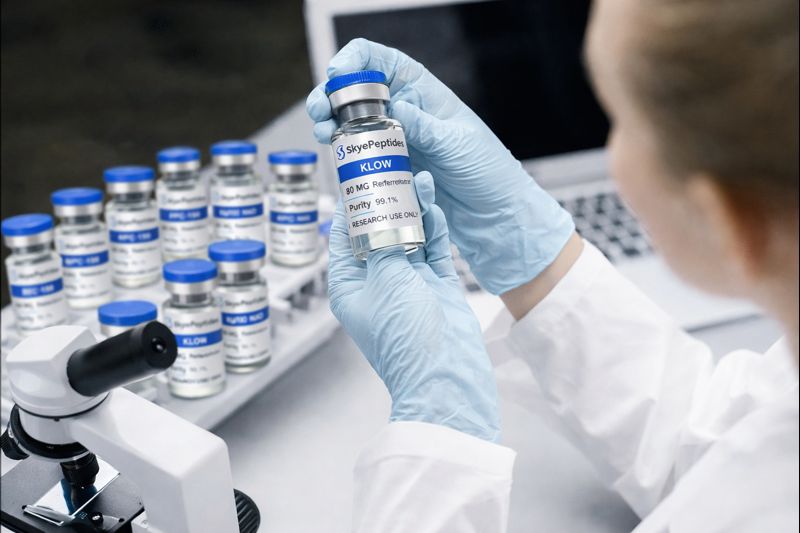

CJC-1295 without DAC (commonly referred to as CJC-1295 No DAC) is a synthetic growth hormone–releasing hormone (GHRH) analog developed for laboratory and experimental research use. Unlike its DAC-modified counterpart, the No DAC variant is designed to maintain a short biological half-life, making it particularly useful for studies focused on natural, pulsatile growth hormone (GH) secretion and endocrine signaling dynamics.
Because growth hormone physiology relies heavily on pulsatile release patterns, CJC-1295 without DAC has become an important research tool for investigators seeking to model endogenous hormone regulation more accurately in preclinical and experimental settings.
Understanding CJC-1295 and the Role of DAC Modification
CJC-1295 is a 30–amino-acid peptide that structurally mimics endogenous human GHRH. Its primary biological role is to stimulate GHRH receptors in the anterior pituitary, triggering the release of growth hormone. Once released, GH exerts downstream effects by stimulating insulin-like growth factor 1 (IGF-1) production, primarily in hepatic tissue, which then influences growth, metabolism, and tissue repair pathways.
The DAC (Drug Affinity Complex) modification is engineered to bind the peptide to circulating plasma proteins, significantly extending its half-life and duration of action. While this modification is advantageous for long-term GH elevation studies, it alters the natural rhythm of GH secretion.
In contrast, CJC-1295 No DAC lacks this affinity complex, resulting in rapid clearance from circulation. This shorter duration more closely resembles native GHRH activity and allows researchers to investigate physiological GH pulses without prolonged receptor stimulation.
Mechanism of Action of CJC-1295 No DAC
CJC-1295 No DAC exerts its effects by binding to GHRH receptors located on somatotroph cells in the anterior pituitary gland. Upon receptor activation, a signaling cascade is initiated that promotes the synthesis and release of growth hormone in discrete pulses rather than continuous secretion.
This pulsatile release pattern is essential for normal endocrine function, as it influences receptor sensitivity, downstream gene expression, and metabolic regulation. By preserving the short-acting nature of endogenous GHRH, CJC-1295 without DAC allows researchers to examine acute GH signaling events and their immediate physiological consequences.
Because the peptide does not remain active for extended periods, it minimizes prolonged GH exposure, which can otherwise complicate data interpretation in experimental models.
Research Applications of CJC-1295 No DAC
The pharmacokinetic profile of CJC-1295 No DAC makes it well suited for a variety of laboratory and preclinical research applications, including:
- Growth hormone pulse dynamics, examining frequency, amplitude, and timing of GH release
- IGF-1 regulation studies, focusing on tissue-specific responses to acute GH stimulation
- Metabolic research, including glucose metabolism, lipid utilization, and energy balance in animal models
- Regenerative and musculoskeletal research, where short-term GH signaling is evaluated in tissue repair and recovery models
- Endocrine physiology studies, exploring feedback mechanisms and receptor sensitivity
Because dosing can be precisely timed, researchers are able to investigate cause-and-effect relationships between GH pulses and downstream biological responses with greater accuracy.
Comparison Between CJC-1295 No DAC and CJC-1295 With DAC
While both variants share the same core peptide structure, their experimental applications differ significantly due to pharmacokinetic differences:
- Half-life: No DAC has a short half-life, whereas DAC-modified CJC-1295 is long-acting
- Administration frequency: No DAC requires more frequent administration in sustained studies
- Physiological relevance: No DAC more closely replicates endogenous GH pulsatility
- Research focus: without DAC is favored for acute and mechanistic studies; DAC variants are often used for chronic GH elevation models
Understanding these distinctions helps researchers select the appropriate peptide based on experimental objectives and study design.
Scientific and Laboratory Considerations
As with all peptide-based research compounds, proper handling and verification of CJC-1295 No DAC are essential. The peptide is typically supplied in lyophilized form and should be reconstituted under sterile laboratory conditions using validated solvents. Storage at refrigerated or frozen temperatures helps preserve stability and prevent degradation.
Analytical verification methods such as high-performance liquid chromatography (HPLC) and mass spectrometry are commonly employed to confirm peptide identity, purity, and batch consistency. These steps are critical for ensuring reproducibility across experiments.
Experimental protocols must also account for precise timing and dosing schedules. Since the peptide’s effects are short-lived, deviations in administration timing can significantly alter GH pulse patterns and compromise study validity.
Conclusion
CJC-1295 No DAC is a valuable research peptide for studying growth hormone physiology, IGF-1 modulation, and short-term endocrine signaling. Its lack of DAC modification allows it to closely mimic natural GHRH activity, making it particularly useful for investigations into pulsatile GH release and acute hormonal responses.